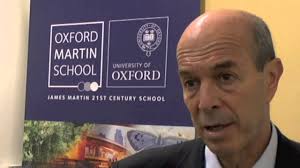
To Oxford Martin School to see Ian Goldin, former Vice President of the World Bank and former economic advisor to Nelson Mandela.
Goldin believes development is the no.1 issue facing humanity - why do some societies and some individuals develop, get richer, get rights etc....while others don't? Why is GDP so pre-dominant, meaning that destructive practices (e.g. environmental harm) are counted as economic acticity - in short, "why are the bads of economies counted as goods?"
Goldin traced the trajectory of development over recent decades. Dependency theory led to uneven development which countries tried to address through import substitution, but countries are generally not very good at state-controlled production and then the oil price rises of the 1970s led to a vicious cycle of debts and bail-outs.